
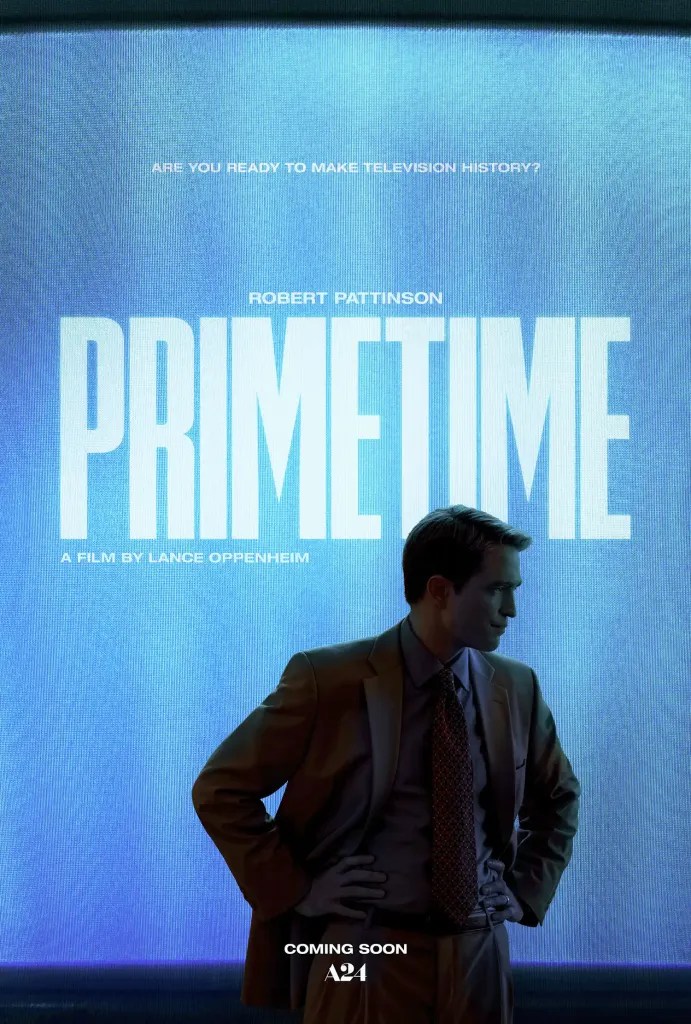
Lance Oppenheim | Primetime | A24 | September 2026 | 110 minutes
Primetime was always going to be a complicated film. Director Lance Oppenheim has been praised for his entertaining and unorthodox approach to documentary filmmaking on projects such as Some Kind of Heaven, Spermworld, and Ren Faire, with a touch that has historically read as less journalistic and more like creative nonfiction, crafting narratives via selected events much in the way a reality TV producer might, with considerably more cinematic flair. As an artist, Oppenheim is undeniably talented: as a hardline documentarian, we can start making denials. Given this, the world of biopics seems almost tailor-made for his skillset, where he, by all rights, would have far more natural liberty to weave the tale he chooses to tell through selective reality. But the story of To Catch a Predator is such a knotty ethical mess to tackle even when sticking to the hard facts that even approaching the material from the angle of a biopic becomes its own separate ethical concern. From a technical filmmaking perspective, Primetime is plainly remarkable, but its scripting succumbs to a pitfall that was perhaps always unavoidable: when presenting a struggle between two parties ie. child solicitors and those who capture them for profit and spectacle, how do you primarily focus on reasonably criticizing the latter?
This is not at all to say that Primetime ever excuses pedophilia, despite what some might say. There are occasionally small moments that read as attempts to humanize some of these individuals, turning them into ever so slightly more than dangerous freaks. But these attempts are slight: the child solicitors in Primetime are mostly kept at a distance. Attempts at criticism towards these individuals generally take the form of presenting them as pathetic more than anything, which is how To Catch a Predator as a show often presented them. Additionally, Hansen (Robert Pattinson) often repeats the chat logs to himself like a mantra throughout Primetime, reminding himself (and us) that the child solicitors he goes after are not especially worthy of sympathy. This is perhaps the best approach one could take in a film like this, yet it is still a deeply flawed one. Even though Primetime technically never excuses or endorses pedophiles, the nature of its subject matter places it in a situation where it actively criticizes what nearly everyone would agree is the lesser of two evils while doing less to address the greater one. The messiest instance of this arrives when Hansen’s team entraps an older rabbi who refuses to play Hansen’s game. When Hansen grows frustrated, the rabbi – who is there to have sex with a child – is used as a sort of proxy pulpit to criticize Hansen for daring to believe he has the right to do what he does. It’s a case of right message, egregiously wrong messenger.
There are three core characters and character arcs that sit at the heart of Primetime and each is a part of Hansen’s team. There’s Hansen himself, Andie Bender (Merritt Weaver), Hansen’s producer who is very notably not an actual person but a loose composite character based on multiple producers, and Dan Plum (Skyler Gisondo), also not a real person but based off of real To Catch a Predator decoy actor Dan Schrack, much in the way Marty Supreme’s Marty Mauser was based off Marty Reisman. I have some inherent issues with this set-up, in that there are dangers in heavily fictionalizing select aspects of the To Catch a Predator story while maintaining accuracy around others – most obviously Chris Hansen’s name. There is a level of intent to Primetime that cannot be ignored and most of that intent is to criticize Chris Hansen. And it is not that Chris Hansen is or should be above criticism – he is not – but such criticisms begin to lose a lot of weight when Oppenheim and scriptwriter Ajon Singh change so much to fit the narrative they are interested in telling.
Pattinson’s turn as Chris Hansen is strange in that it’s both laudable and frustrating in nearly equal measure. He’s given many balls to juggle here – arguably too many – as he attempts to embody Chris Hansen as a man, as a meme, a symbol, and – to some degree – an audience proxy. He is transformative in how he adopts Hansen’s mannerisms and vocal cadence and how he conveys moments of pettiness, narcissism, and mania. He is, quite frankly, scary in this role, at one point hitting a slasher pose, at others, awash in the film’s beautiful yet sinister color grading. Oppenheim and Singh project upon him a reason as to why he does what he does: a deep-seated insecurity in his own personal goodness and a need to establish said goodness by taking down people who are worse than he is.
This may be the ultimate “point” that Primetime is trying to make: that there is a “bully” in many of us that is more prone to surface when we feel powerless, and knowing this, we will seek out targets who we feel deserve such treatment in order to feel empowered and better about our own shortcomings. This is reflected in Hansen’s obsession with “the whale,” who turns out to be Bill Conradt (Alex Winter), the former assistant DA who infamously committed suicide during a To Catch a Predator sting op. This is predictably the climax that Primetime builds towards. What can’t be divorced from this is the subplot regarding Hansen’s infidelity. Hansen carries an immense amount of shame – if not guilt – from cheating on his wife (Anna Faris). When a National Enquirer reporter threatens to publish photos of him with his mistress, Hansen becomes desperate to catch “the whale,” believing that if he can catch a bad enough guy, it will absolve him of his shame and that his wife will forgive him.
This is a pretty layered plot thread, but the level of assumption and exaggeration of Hansen’s character required to get to it feels a little odd. There’s nary a moment where Pattinson’s Hansen doesn’t feel like a deeply weird and pathetic individual as he loses his temper over a vending machine not dropping his snack, has an American Psycho-esque break-up dinner with his mistress, introduces himself with his full name on a call with his wife, mockingly babbles at his producer, or devolves into a melting puddle of a man when things don’t go his way. Anecdotal accounts and television footage suggest that while Hansen might’ve been ethically flawed in his approach and placed a lot of value on ratings and attention, he was not nearly this constantly erratic. At times, Hansen feels almost inhuman, and it’s impactful and chilling when I observe it in a vacuum, but somewhat parodical when I observe it next to the reality that Primetime is based upon. The Hansen of Primetime occupies a strange liminal state of being: not quite real or fictional, but unreal and uncanny. It’s very interesting: I’m not sure I like it.
My praise for Merritt Weaver and Skyler Gisondo is less qualified. They both benefit from not being named after immediately recognizable TV personalities, but also just by being afforded quieter, more grounded roles and character arcs. Weaver’s Andie Bender is awful (complimentary). She’s the cold, unfeeling engine that keeps To Catch a Predator from spinning off the rails whenever Hansen becomes overly invested in his more sympathetic but delusional Mandate of Heaven. Her character arc is the least complex of the three, but as a result, it also comes with the least amount of baggage. She’s got plenty of stellar, memorable line reads and she’s entertaining and borderline evil without ever feeling like a cartoon character. She’s great.
And Gisondo as Dan Plum is the true heart of the film. If Primetime makes any strong, salient critique against To Catch a Predator that feels as though it doesn’t have to fight its own optics battle, it’s that the show undoubtedly was exploitative in its use of struggling actors as decoys. There’s something inherently messy about asking real people to “act” opposite people who are not acting, especially those who are dangerous. Oppenheim has admitted to being a fan of Hansen – despite the largely negative portrayal in this film – praising the creative innovation of his decoy casting, likening his entrapment sets to those of David Lynch’s Blue Velvet, and making the case for Hansen as an auteur. It feels worth mentioning that Oppenheim’s next documentary, You Can See Everything, is a collaboration with Nathan Fielder, who is similarly known for casting actors in real scenarios in order to “control” reality. Though this might cast suspicions of Oppenheim’s intent with this plot thread, or render it as self-critical or hypocritical, Primetime is rather unambiguous in how it portrays Plum’s grooming under Hansen’s wing. Even with the exaggerations, actors cannot be reasonably expected to handle the stresses of “performing” opposite sex criminals. There’s a version of Primetime where Chris Hansen has a different name, and To Catch a Predator has a different name, the network is different, and there is greater emphasis on Hansen and Plum’s relationship, rendered parallel – if not equal – to the abuses they oppose. Maybe there’s a version of Primetime that does less to turn Hansen himself into a spectacle for entertainment and places more emphasis on his actions as opposed to his mannerisms. Maybe that film is David Osit’s Predators.
But that’s just not this film. This film is brilliantly shot, colored, and acted. It succeeds on nearly every level that a film should be expected to succeed upon, and yet its narrative is almost wholly encumbered by muddy messaging. When Plum sings “Seasons of Love” from Rent to Conradt on the phone as he breaks down, calling back to his audition tape, Primetime feels more “written” than many purely fictional works. When tackling something as nuanced and real as the spectacle of punishment culture that has resurfaced and continues to proliferate and endure post-9/11, and To Catch a Predator’s role in it, that’s a problem.
Travis Shosa is a writer from Spring, TX. They are the EIC and managing editor of Dodo Eraser. Their creative writing is featured in Stanchion, Maudlin House, HAD, Bending Genres, fifth wheel press, HAWKEYE, Some Words and lots of other cool places. They have been nominated for the Pushcart Prize and Best of the Net. Their journalism has been featured in Pitchfork, Bandcamp Daily, The Line of Best Fit, PAPER, and others.
Leave a Reply