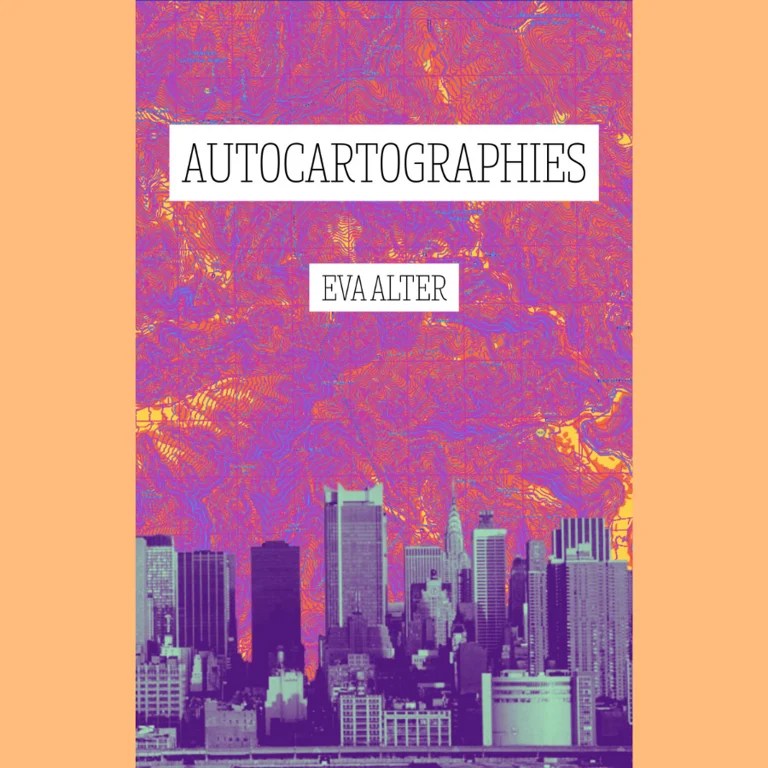
Eva Alter | Autocartographies | Eulogy Press | October 2025| 31 pages
In the seventh stanza of “Balancing Rock,” a hiking narrative featuring an autobiographical speaker, poet Eva Alter describes a resurging unity of mind and flesh: “I could / think again [ ] rhythmed temperate terrain / brought me back to my body” (24). By the time readers arrive at the poem’s final line, continued patterns of sound and movement have led the speaker “back to myself” (24). Like many of the poems in Autocartographies (2025: Eulogy Press), Alter’s debut chapbook, “Balancing Rock” features prescribed syllable counts, limited punctuation, and use of blank space, choices that prompt readers to experience the poet’s concept of “rhythmed” awareness. By employing such experimental forms of rhythmic language to encounter, map, and re-integrate the dissociated aspects of an embodied self, the five sections of Autocartographies offer not only a vulnerable window into the world of the writer, but also a fascinating pairing of concept and procedure that readers might use to re-examine their own interior disunities.
The book’s first section, titled “Orientation,” is a trio of autobiographical poems which establish a foundation for the work to follow. Some of the expository detail is conceptual, as in the title poem, “Autocartographies,” whose speaker asserts that “rhythm [ ] displaces / knowledge [ ] of [ ] dozens of self-fractures [ ] sheer // procedure [ ] directs [ ] a self that [ ] people / know” (3). Other key moments reveal personal history, such as the family dynamics described in “Barometer,” a meditation on the child’s perception of “fault- / lines [ ] of flesh [ ] fear [ ] and failure” (5). Both types of detail converge in “The Manse,” which shows the poet’s early encounter with rhythmic constraint as a tool for self-regulation:
she displaces conversation a room over
by counting to eight. One, two, three, four, five
six, seven, eight. Two, two, three, four, five six— and
on. She learned this from her dance teacher. She’s
become to rely on it, pulsing her
miniature life—preschool, dance, and church—
to the rhythm of eights, sixteens, twenty-
fours. She is only in her head, sequenced
by her whispered counting . . . (4)
Readers who count along may notice that each line has precisely ten syllables. Both form and content connect present-day Alter, the experimental formalist, with young Alter, the girl “pulsing her / … life” with controlled rhythm.
In the second section, “Pattern Recognition,” found poems collected from psychiatric, religious, and information systems texts further establish the rationale for Alter’s procedure. “Compartmentalization Pattern,” the book’s longest piece at three pages, presents readers with four sections of free-floating erasures of Elizabeth F. Howell’s The Dissociated Mind. The word “trauma” recurs five times, along with “traumatized” and “traumatology,” in the discussion of
event(s)
that could not be assimilated
cannot link with other experience[s]— now a
structural
result: dissociation,
splits and fissures in
the psyche (8)
Shortly after this description of submerged and disconnected aspects of self, the text introduces the idea that their subject positions remain intact, exerting influence from their locations in the body. “[S]omatic / consciousness affects perception identity memory” (8), assert Alter & Howell, even as the conscious mind labors at “keeping [ ] experience out / of awareness” (8). The other compositions in this section further explore the darkness of non-awareness (via Robert Alter’s translation of Psalm 88) and the systemic duality of mind and body (via informational text on “Entities, Functional Requirements for Bibliographic Records”). Eva Alter’s work with found text skillfully integrates these complex frames for meaning, a choice that offers readers a depth of experience which belies the book’s slim spine.
In the third section, “Mythogenesis,” Alter’s speaker offers poems that demonstrate rhythm as a tool for self-exploration. All three use her signature form of ten-syllable lines systematically broken both vertically (into couplets) and horizontally (by intentional use of space). Alter plainly describes this constraint in the book’s afterword: “I decided to approach material I’d been avoiding for much of my life by applying a simple formal constraint to most poems: ten-syllable lineation. By providing my mind with a rule and rhythm, I was able to articulate patterns that have haunted me since childhood” (31). One of the book’s most striking poems, “Chimera,” uses the mythological figure of a beast with mismatched parts to describe the conscious subject’s encounters with these hidden aspects of self:
that chemical frontier fracturing me—
memory and impulse exposed removed—
synapses shaved somewhere unreachable—
into a fragmented creation I
took the wolf’s teeth deer’s antlers falcon’s wings
Mother’s voice Dad’s skill of self-displacement
But the mutation did not destroy its
progenitor My body— on the bow—
and my chimera-self— behind the hatch—
instantly knew of each other’s presence (15)
Readers may also notice the spare punctuation: there are em-dashes and the occasional colon, but no periods, semicolons, or commas that would inhibit continued motion. The resulting cascade of text on the page is evidence of what appears to be a kind of flow state, akin to hypnosis, in which conscious mind releases decision-making to constraint and allows itself to be led to otherwise inaccessible destinations.
The fourth section, “Embodiment,” features three more poems that continue using this technique to circumvent the mind and inhabit the body. A poem with a colloquial title, “Idk how to write about my eating disorder anymore LOL,” invokes the metaphor of static to describe the mind’s interference with somatic consciousness. The speaker first describes “the denial // of self exchanged [ ] for fixed [ ] distortion” (20), then evaluates the result:
It worked for a while surroundings muted
[droning radio static internal
sustained— Mom’s voice on perpetual loop]
mind near-possessed by a singular goal
somatic suffering numbed and vacant (20)
In the poem’s final couplet, Alter’s speaker describes her experience of a breakthrough moment after “thirteen years” (20) of static: “some part of me [ ] stood [ ] shut off the radio: / the first time since fourteen [ ] I [ ] sensed silence—” (21). The poem itself is both instrument and record, offering readers a chance to witness the remaking of a fractured self on the page.
The book’s fifth and final section, “Protocols,” features three poems that offer further reflection on method and result. In “Necessary Endurance,” Alter alludes to Laurie Halse Anderson’s “Speak,” a novel about surviving trauma that is alternately taught and challenged in high school curricula, in order to offer readers their own agency: “Articulation [ ] of experience / [ ] that original form [ ] of survival / [ ] belongs to us all [ ] carries us onwards” (27). Alter’s use of first-person plural to implicate the reader here is notable; the only other poem to use it (“Barometer”) does so in the course of describing the “us” of a family memory. The book’s closing poem, “Arbitration,” returns to first-person singular to offer a final testimony: that the concrete result of “rhythm [ ] descending [ ] upon [ ] memory” (29) is healing. “I see the child— [ ] I forgive her—” (29) writes Alter, a potent speech act—after the philosopher of language, John Searle—that reconciles conflict using the tools of language and awareness.
In her afterword, Alter describes the process of composing Autocartographies as a “psychic purge” that “restored my voice” (31). She then goes on to encourage her audience, telling us that “It is possible to map your way to survival, healing, and hope” (31) and that “If you have lost your voice, you can restore it to yourself” (31). In this sense, the maps offered by Alter’s work are not only personal artifacts, but also procedural blueprints. Readers with interest in embodied processing, rhythmic constraint, or the reconciliation of trauma should buy this book.
D.W. Baker is a poet and critic from St. Petersburg, Florida. His reviews and essays appear in Paraselene, Vagabond City Lit, Version (9) Magazine, Radix Magazine, and more. His poems appear in Dodo Eraser, Eulogy Press, RESURRECTION magazine, and Apocalypse Confidential, among others, and have received nominations for Best of the Net and the Pushcart Prize. He reads and reviews for Variant Lit and Philly Poetry Chapbook Review. See more of his work at www.dwbakerpoetry.com
 Dodo Eraser
Leave a comment