
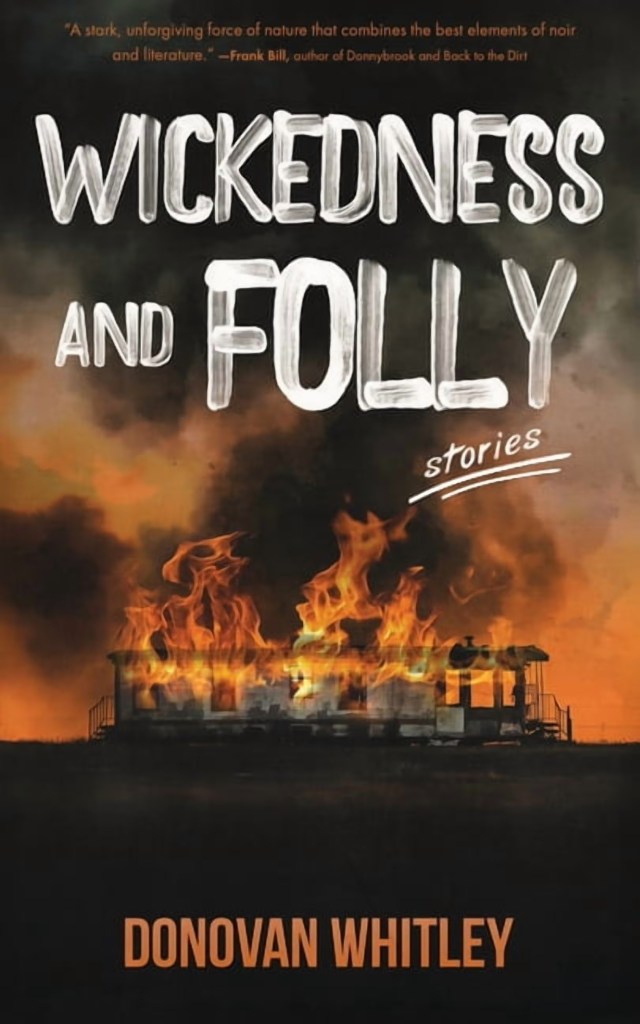
Donovan Whitley | Wickedness and Folly | Leftover Books | March 2026 | 130 pages
Donovan’s Whitley’s debut short story collection is hilarious dark comedy about degenerates and the horrible choices they make—and the terrible consequences. There’s no heroes coming forward in Whitley’s cast of sad sacks and his stories have taken on an extra force as they’ve come closer to the real America of drug addiction, alcoholism, and white trash. Drug addiction has a humanizing effect in most contemporary fiction—addicts are portrayed as innocent victims of pushers and malign drug companies. They, these fictional addicts, want nothing more than to get into therapy/counseling and get clean, which in reality is very rarely the case. Whitley lets realism take over his stories, his characters rob/get robbed, kill/get killed, lie and cheat as their lives revolve around getting their next fix and getting the money to get their next fix. Even the characters who aren’t addicts do not harbor much life ambition—an oil rig worker who hates his job aspires to some day be a cattle truck driver.
The nine stories here take place in various locales from the mountains of the New Mexico desert to the boiling plains of Kansas and offers great scope for Whitley’s power of description. He thunders in a way that brings Cormac McCarthy to mind:
“The world he was headed toward seemed infinite, uncharted. Out across the benevolent desert lands, the rain had slacked, the telephone poles were going, the distant wind turbines stood like sentinels under the gibbous moon. And over there run a parcel of deer. In their lunar castings their shadows keep another quadrant and these animals, loping, seemed imbued with a purpose antecedent to their origins. Both imperious and remote. Something divorced from their bosoms that was yet a blood constituent that transcends even you and I.“
Readers will find themselves often asking about Whitley’s characters What’s this dumbass going to do next? such as when one who paid for his dope and is waiting for his dealer to count the money. When the dealer says he’s short, he tells him to count it again: “No. Huh uh. I’ve already counted it twice. You know what that would mean if I counted it more than that and expected a different result? It would mean I’m practicing insanity. And I’m not insane. So where’s the fifteen bucks left on this balance?”
A noir writer can still only kill off so many of his characters and Whitley is good enough at spreading the sympathy around that you don’t want to see the poor drunk who wandered into the wrong home in the middle of the night to die after he gets shot by the home’s owner. In the story “Water Through a Sieve,” a cancer patient is wondering whether or not he wants to continue the grueling chemo treatments. He’s also recently found out his wife has been having an affair—by catching them fucking in his car in their own driveway. The anguish of it all is becoming unbearable for him:
“Then you walk in that hour of the night in which no clock names, in your sleepware, and walk far off from your usual street, down along a trough of closed storefronts, watch as you ripple from one darkened pane to another, and you stop, look in on your ghost in the glass, and you see your face turning back every moment of your life like the reel of a slot machine, and then you climb atop the railing on the bridge spanning the river and before you leap you think: I was alive.”
Whitley moves toward seriousness through his wit. In the story “A Reasonable Amount of Trouble,” two characters are on their way to dispose of a body in a wood chipper. When they arrive on scene they go to retrieve the body, which had been stuffed in a barrel, from the pickup truck bed. The barrel isn’t there. They get back in the truck and drive the way they came, looking for the barrel and find it in a ditch beside the road. As they try to get it up out of the ditch a cop car stops and lights them up. This is the kind of luck that dogs many of Whitley’s characters, but sometimes they catch lucky breaks like the man whose search for the person who stole his dope is interrupted when he gets sent to jail. As luck would have it, he finds the thief in the jail with him.
Wickedness and Folly serves the purpose of what short stories are supposed to do—entertain and inform. We get a good lesson on oil rig nomenclature and a visit to a crack house:
“The insides of this slattern shack of the damned smelled awful. I’d never actually gone inside before—I’d only been as far as the door, but as soon as I stepped in, I coughed up the caustic tang of bile. It smelled like death had been covenant with this place since Christ. He led me through trash and white dogshit to the drawing room. There was blood everywhere and a partially butchered human corpse. My insides folded in on themselves.“
He gives us the Jack London-esque perspective of a wolf in the Sierra Blanca mountains of New Mexico: “She leapt after it, swift and deft as a serpent’s strike, her canine grin shone milkblue in the moonlight. In a single graceful motion, the she-wolf hooked her claws into the raccoon’s ribs, cocked her skull and sank her teeth into its neck….The raccoon went limp in her jaw-clasp. The she-wolf rose and went on, the little skull of the raccoon lolling with her progress.”
With his dense and broad vocabulary, each of Whitley’s short stories covers nearly as much ground as a novel (and chases us to a dictionary from time to time). But if he’s going to be Cormac McCarthy’s heir apparent, he’s going to have to give us a novel. I’d really like to see him try.
Hugh Blanton‘s latest book is The Pudneys. He can be reached on X @HughBlanton5.
 Dodo Eraser
Leave a comment