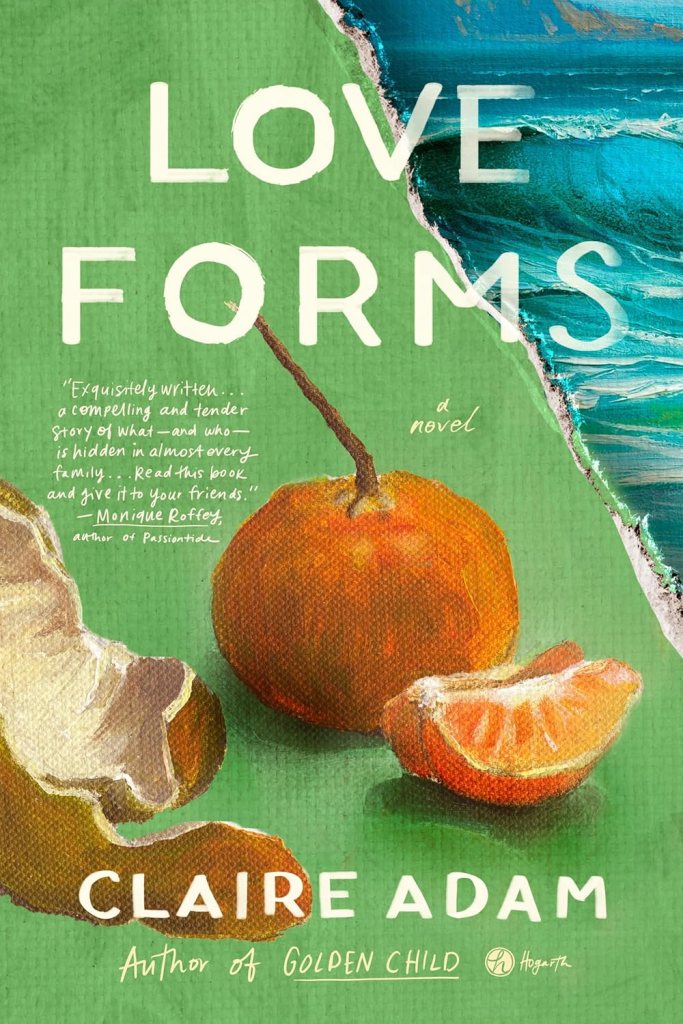
Claire Adam | Love Forms | Hogarth | July 2025 | 271 pages
Dawn Bishop, the main character and narrator in Claire Adam’s latest novel Love Forms, grew up in Port of Spain, Trinidad. Her father Kenneth Bishop ran a fruit juice empire that made the family rich, but his modesty prevented any ostentatious displays of wealth. A Catholic family, they attended church somewhat regularly, never missing the major services at Christmas, Ash Wednesday, etc. During Carnival each year they left town, Mr. Bishop saying it’s not respectable to take part in or even be around. It was a standing joke in the churches of Port of Spain that “it” always happened at Carnival. In church on Ash Wednesday, people would be looking around at the young girls to predict which ones would be in trouble. Over the next few months girls would quietly disappear from public view, reappearing around Christmastime, “thickened and aged with weak excuses that no one believed.” Dawn had never been allowed to attend Carnival until the year she turned sixteen. And “it” happened to her. When Dawn’s pregnancy was discovered, her parents had her secreted away to a church in Venezuela where she would stay until she gave birth—and give up the child for adoption.
Genealogy websites like 23andMe and GEDmatch do more than just help cops catch criminals with DNA evidence—the FBI nabbed the Golden State Killer using publicly available information on GEDmatch—they can be used by adopted children to search for their birth parents and vice versa. There are also internet forums where parents and children can post their relevant information hoping to find each other. Forty years after Dawn was forced to give up her daughter at birth she begins a search by registering and posting on various forums. Dawn doesn’t remember the name or location of the church where she gave birth, so she can’t be very specific about what she posts on the forums: “Bio mom seeking bio daughter; region Latin America and Caribbean; decade 1980-1990.” She doesn’t get many responses, in fact it’s rare that anybody on the forums gets a response, but she did get one reply from a woman in Caracas who could possibly be a match. Turned out she was just a scammer and took Dawn for quite a bit of money.
In 1979, China enacted its one-child policy, resulting in an epidemic of kidnappings in the 1980s. Desperate parents were posting fliers and taking out ads in newspapers trying to find their lost sons (it was almost always boys who were kidnapped). Li Jingzhi’s son, Mao Yin, was kidnapped in 1988 when he was one-and-a-half years old. She never stopped searching for her son and in 2020 someone responding to one of Li’s ads sent her a picture of an adult man who they thought may have been kidnapped in the province and during the time Mao Yin went missing. Li contacted him, they agreed to take DNA tests, and it was a match. After thirty-two years she’d found her son. Even today, the Chinese Ministry of Civil affairs helps maintain a website called Baby Come Home where children and parents can search for one another. The reunions are all too rare, but they do indeed happen.
Dawn had cut back on checking her email for notifications for replies to her posts on the internet forums; after years of nothing but the scammer contacting her, she became disheartened. Not long after she began her search she and her husband divorced and she lives alone in a small apartment in London earning a living as a clerk in a leasing agency. Her two sons, Finlay and Oscar are grown. After ignoring her email account for days, she checks it and finds an email that had been sent to her four days ago notifying her of a reply to one of her posts from someone named Monica Sartori. Monica was adopted in Venezuela as a child and she’s searching for her birth parents. They begin communicating with each other, and the timelines are close. They have similar hair and skin. They agree to take DNA tests.
Over the years, Dawn’s parents had been telling her to stop searching for the child. Dawn’s mother flew into a rage when Dawn asked her if she knew where the child was, her father reminds her that they had made a “pact” the night she was sent away to Venezuela to never mention it again. They remind her that she’s got a good life in London; married to a doctor (Dawn was a doctor herself but stopped practicing to raise her sons), and has a wonderful family. It’s as if she’ll never be forgiven:
“But it was so long ago; I can look back now and feel sympathy for my younger self, and tenderness, and I can see it the way [other people] might see it, which is to see not only one foolish sixteen-year-old girl who got herself in trouble—I know, I know—but all the foolish sixteen-year-old girls. There are so many of us, and each of us had our own ‘terrible night,’ and each thought we were the only one to ever suffer through it. And while the suffering was real, the perspective on it changed over the years, so that, to call it, in the melodramatic words of a daytime soap opera, ‘a terrible night,’ was to both tell the truth of what had been felt, and to be gently teasing too, to mock or expose the foolishness of youth. It was comforting. It made it possible to laugh at yourself a little bit, and God knows we needed to be able to laugh sometimes, after all that crying.”
Shortly before sending in her DNA sample, Dawn had arranged for a vacation at the family beach house in Tobago. She’s told her mother about the impending test results, and oddly her mother has no objections—she in fact seems eager to know about her long lost granddaughter as well.
Claire Adam said in an interview with the Booker committee (Love Forms was longlisted for the Booker Prize) that she “wanted to explore the bond between mothers and their children. On one hand, it’s the most ordinary, mundane, taken-for-granted thing in the world…on the other it’s deeply mysterious. In the case of a mother and child who’ve been separated since birth, for example, often there is a pull towards each other that lasts a whole lifetime. These are people who don’t know each other, who’ve basically never ‘met’—and yet they yearn to be together. Why is that? It seems to defy rational explanation.” Adam’s first novel, Golden Child, also takes place in Trinidad, and also involves a missing child—a teenage boy who goes out for a walk and doesn’t come home.
Adam clearly perceives Dawn Bishop’s motivations and feelings, she says she spent many hours researching what a mother looking for a child given up at birth would do—what Venezuelan government agencies she would contact for information, she even spent hours outside the Venezuelan embassy in London just to watch the comings and goings. Adam found printed maps of the Caribbean and Venezuela to get a feel for how Dawn would try to find the places she might have been in Venezuela (Dawn began her search in pre-internet days) where she gave birth. Even though Dawn is at home with her family as she awaits the results of the DNA test to come in—she’s utterly alone.
Hugh Blanton‘s latest book is Kentucky Outlaw. He can be reached on X @HughBlanton5.
 Dodo Eraser
Leave a comment